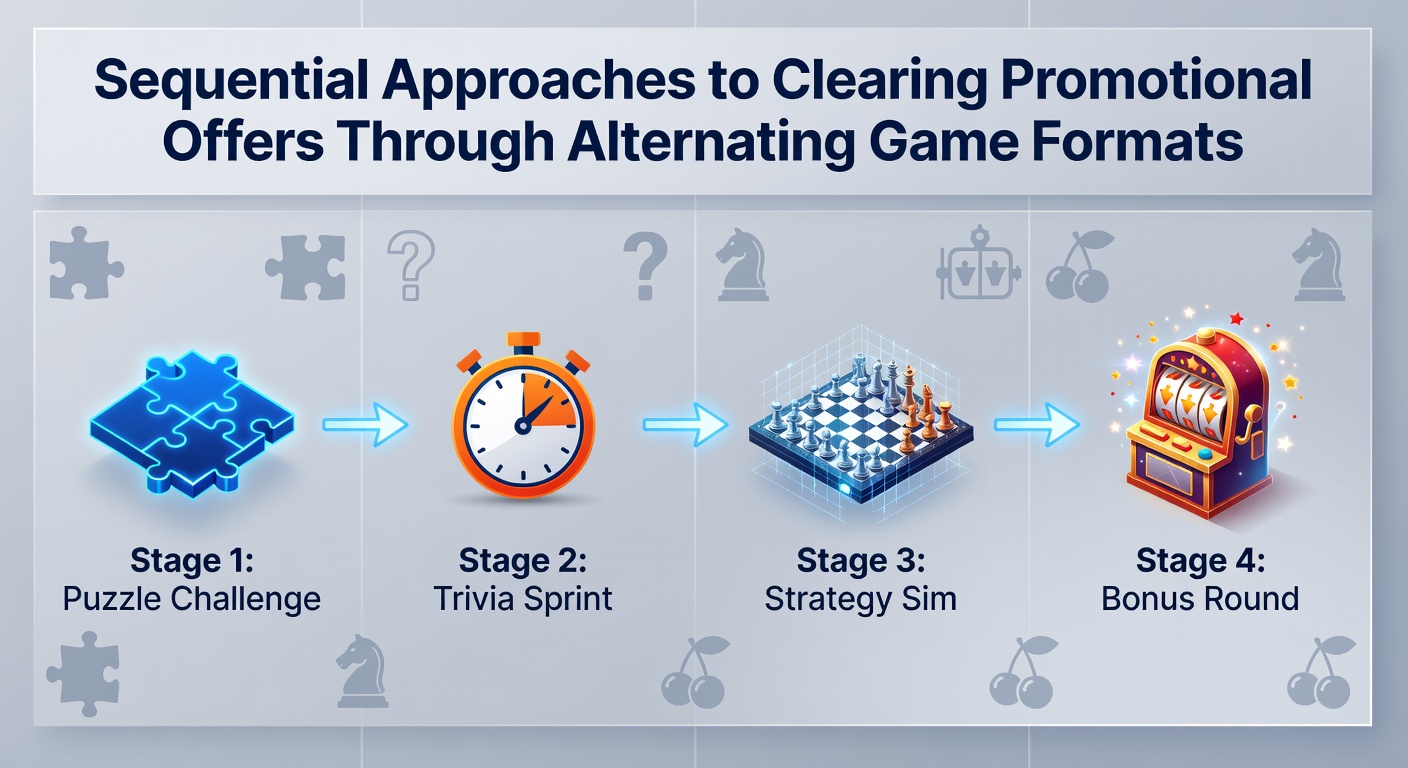
Sequential Strategies for Navigating Promotional Requirements via Game Format Rotation
Promotional offers in casino environments often come with wagering requirements that players must satisfy before withdrawing any winnings, and sequential approaches involve cycling through different game formats in a deliberate order to meet those thresholds efficiently. Data from industry reports indicate that games contribute to requirements at varying rates, with slots typically counting at 100 percent while table games such as roulette or blackjack may register only 10 to 20 percent depending on the operator's terms. Observers note that alternating between these formats allows participants to balance speed of progress with risk management across extended sessions.
Those who've examined player patterns find that starting with high-contribution formats like video slots builds initial momentum toward the target, after which a shift to lower-variance table games can stabilize the bankroll while still advancing the requirement at a reduced but steady pace. Research indicates this rotation prevents overexposure to any single mechanic and aligns with how many platforms calculate contributions across categories. Figures reveal that operators in multiple jurisdictions enforce these contribution tiers to maintain game integrity, and players adapt by sequencing their activity accordingly.
Mechanics of Alternating Formats in Practice
Clearing a bonus through rotation begins with a review of the specific wagering terms attached to each promotion, since contribution percentages differ by game type and sometimes by individual title within a category. Experts have observed that many platforms apply full credit to slot machines, partial credit to video poker variants, and minimal credit to live dealer tables, which creates opportunities for structured sequencing. People often find that mapping out a cycle—slots for rapid accumulation followed by measured table play—helps distribute activity without triggering early session fatigue or disproportionate losses.
One study revealed that players who alternate every 20 to 30 spins or hands tend to maintain steadier bankroll levels compared with those who remain in a single format throughout. This approach connects directly to how volatility levels interact with contribution rules, allowing participants to offset high-variance stretches with more predictable segments. Data shows that June 2026 will bring updated reporting standards in several regions, which may influence how operators display these contribution rates in real time and could encourage even more precise sequencing by users.
Regional Regulatory Influences on Bonus Structures
Regulatory bodies outside the UK have shaped how promotional offers function, with the Nevada Gaming Control Board requiring transparent disclosure of wagering mechanics that affect rotation strategies. Similar frameworks appear in Australian state commissions and Canadian provincial regulators, each mandating that operators list contribution percentages clearly so participants can plan sequences without ambiguity. Industry organizations such as the American Gaming Association compile aggregate data showing that alternating formats remain a common response to these layered requirements across licensed markets.
Turns out that when contribution rates change mid-promotion, as occasionally occurs during software updates, players who already employ rotation adapt more readily than those committed to one game type. Academic research from institutions tracking gambling behavior confirms that structured alternation correlates with longer average play durations before requirements are either met or forfeited. Those patterns hold across both online and land-based settings where multiple formats coexist on the same platform.

Practical Sequencing Examples Across Platforms
Take one documented case where a player began with 50 spins on a medium-volatility slot contributing fully, then transitioned to 100 hands of European roulette at 20 percent contribution before returning briefly to slots for final adjustments. Such cycles allow the requirement total to advance while the overall exposure remains distributed. Researchers discovered that repeating this pattern across multiple smaller cycles rather than one extended block often preserves more of the starting balance by the time the target is reached.
Another example involves video poker inserted between slot and table segments because certain variants receive 50 percent contribution credit, creating an intermediate step that smooths the overall progression. Data indicates these hybrid sequences appear more frequently in markets where regulators require detailed game-by-game contribution tables. Observers note that platforms displaying real-time progress meters further support this type of rotation by letting players monitor advancement without leaving the interface.
Integration With Broader Bankroll Management
Sequential rotation connects naturally to compartmentalized bankroll techniques, where separate reserves are allocated for each format within the cycle. Evidence suggests this prevents any single game from depleting funds before its contribution segment completes. Those who've tracked session data across thousands of accounts report that players who predefine switch points—such as after reaching 30 percent of the requirement—tend to sustain activity longer than those who decide transitions spontaneously.
What's interesting is how these methods align with external research from bodies like the Canadian Centre on Substance Use and Addiction, which examines how structured play patterns interact with responsible gambling tools. Although the center focuses on harm reduction, its findings on session pacing overlap with the mechanics of alternating formats for requirement clearance. Operators in EU member states follow similar transparency rules that indirectly encourage players to adopt deliberate sequences rather than unstructured play.
Conclusion
Sequential approaches to clearing promotional offers through alternating game formats rest on documented contribution differences, regulatory disclosure requirements, and observed player adaptations across multiple jurisdictions. Data from industry associations and academic sources continue to track how these rotations evolve alongside platform updates and policy shifts scheduled for mid-2026. People who apply structured cycles consistently demonstrate measurable differences in how far their balances extend while satisfying terms, and operators maintain the underlying rules that make such sequencing viable.